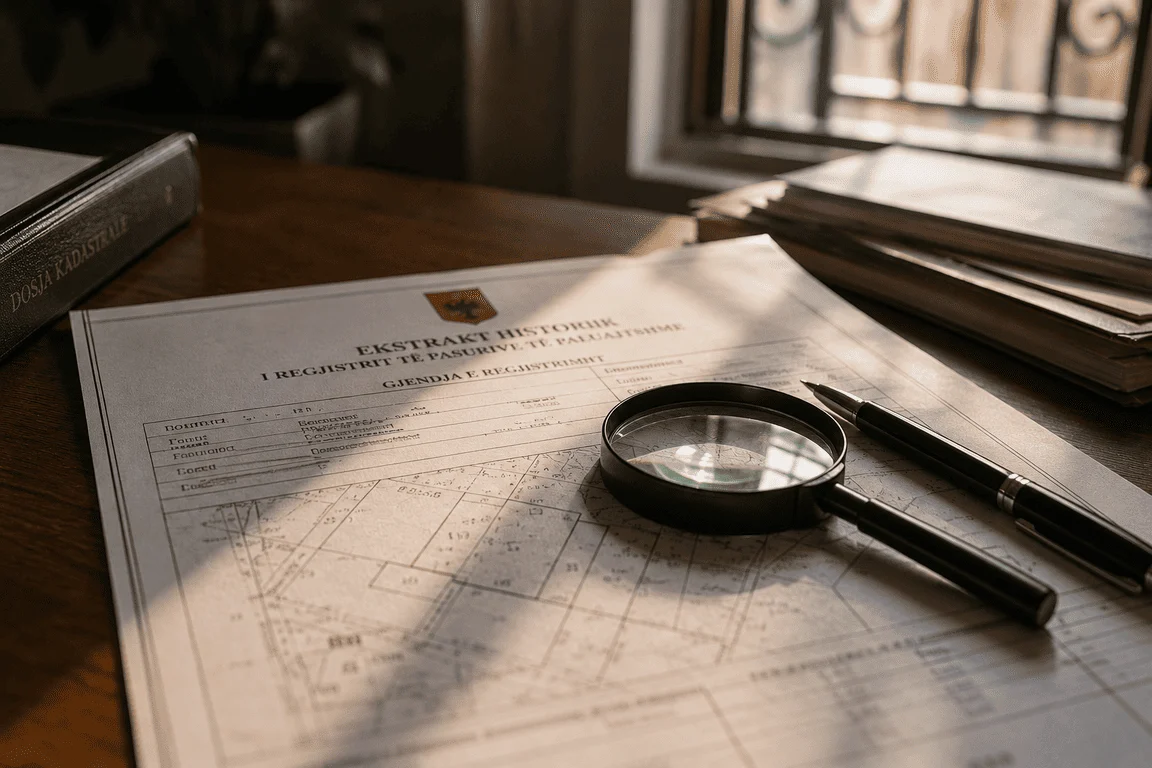
In Albania, as in many countries that have gone through decades of rapid urban transformations, it happens that some buildings or individual units have a less linear documentary history than it seems at first glance. It's not the norm, but it's frequent enough to deserve attention.
The first check: the cadastral kartela
Each property registered in Albania has its own kartela, the cadastral document attesting to its legal existence, boundaries, registered owner and the possible presence of constraints or mortgages. This document is issued by the State Land Registry Agency (ASHK), the entity that has merged the functions of property registration in Albania. Before proceeding with any serious negotiation, it is essential to obtain an updated copy of this document and verify that the data corresponds exactly to the property you are visiting: same address, same size, same owner as in front of you.
Building permit.
A second check concerns the building regularity of the property: verify that the building has been built, or possibly extended, on the basis of a valid building permit. Buildings built without authorization, or with a difference with respect to the approved project, can be in a grey area that complicates the sale, and above all the future resale.
Constraints, mortgages and other situations to know
The cadastral kartela, if read carefully, also reveals whether mortgages, foreclosures or other constraints that could affect the transfer of ownership are on the property. It is one of the reasons why relying on a local professional to correctly interpret this document is almost always a sensible choice: some information is not immediately readable by those who do not know the system well.
Never trust physical possession alone
A mistake that, according to several local legal sources, happens more often than you think: assuming that who lives in the property, or who has the keys, is automatically the legal owner. Physical possession does not equal registered ownership. The only way to be sure is the direct comparison between the seller's identity document and the name on the cadastral kartela.
Concrete help: digital portals
In recent years Albania has invested heavily in the digitization of real estate registers, making it possible to request cadastral information also through online services such as e-Albania. It does not replace the advice of a professional, but it is an additional tool to do a first check before engaging in more in-depth negotiations.
Because two visits are worth more than a long chat
In addition to documentation, it is worth returning to see the property more than once, perhaps at different times, and observe the common parts of the building: a building with neglected shared areas or with never-concluded works often tells something about the overall administrative situation of the building, not only about aesthetics.
Practical advice
Before paying any sum, even just a deposit, always request the updated cadastral kartela and have it verified by an independent local lawyer or consultant, not linked to the seller or the agency. It is a step that costs a few days to wait and a few hundred euros, but that can save you a problem that, once the act is signed, becomes much more complicated to solve.