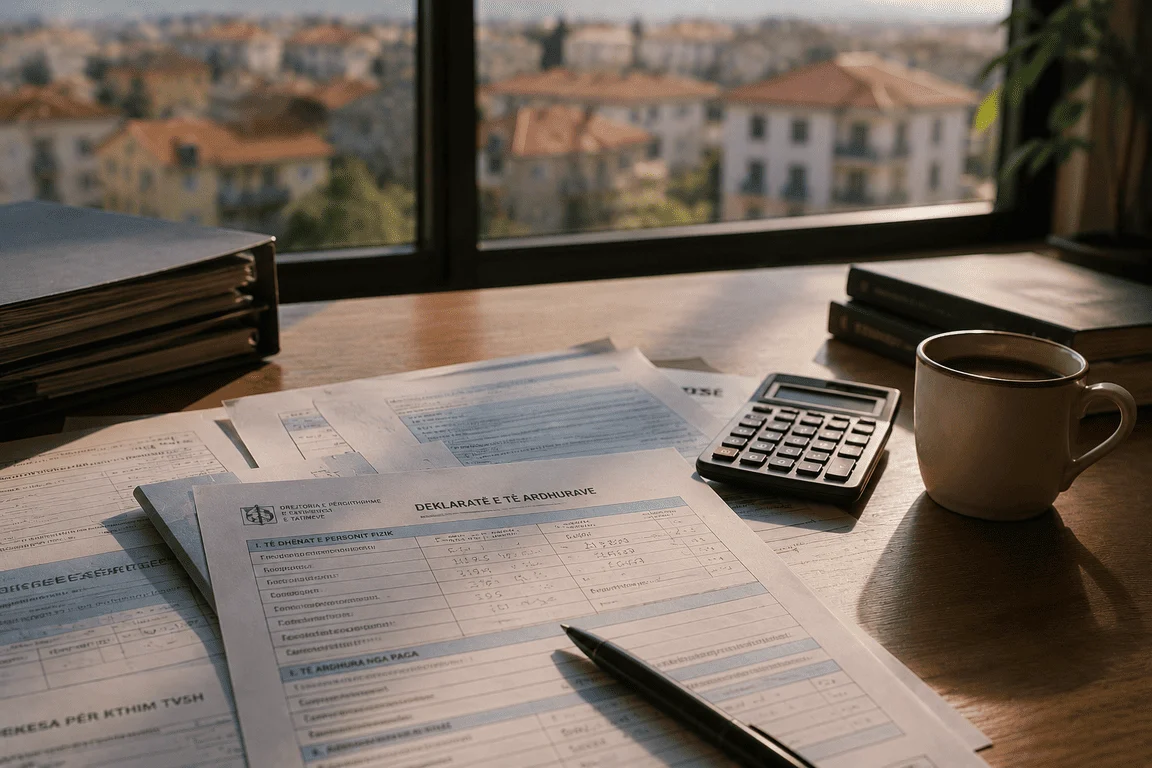
The property transfer tax
When buying a property in Albania, the main tax related to the transaction is that on the transfer of ownership. The rates are not the same everywhere: they vary according to the municipality, the type of property and in some cases its intended use, and can move indicatively in a range ranging from just over 1% to 3-4% of the declared value. Precisely because of this variability, whenever we talk about exact percentages we must check them with the notary in charge or with a local tax advisor at the time of the transaction: these are numbers that can be updated and that depend on specific factors of the individual case.
Who calculates it and who pays for it
Good news, if you can call it that: you don't have to do the math. It is the notary, at the time of signing the deed, to determine the amount due and to retain it before transferring it to the competent tax authorities. You, as the buyer, simply receive the indication of the amount to be paid, included in the total count of the closing costs.
The tax to be paid by the seller
There is also a tax that, although not borne directly by you, is good to know because it is part of the same transaction: the income that the seller earns from the sale of the property is subject to a tax of 15%, the payment of which is a necessary condition for the registration of the transfer of ownership with the competent office. In practice, if this tax is not paid, the registration process can stop, so it is an aspect that also indirectly affects you, as a buyer interested in seeing the transfer of ownership concluded smoothly.
What is not included in this phase
It is worth clarifying what this tax does not include, to avoid confusion. The annual estate tax on real estate, the one you pay every year once you become an owner, is a separate chapter, with much lower rates (in the order of 0.05% for homes), and concerns the maintenance of the house over time, not the purchase. The two things must be kept separate: one is paid only once, the other every year.
Why you should be accompanied at this stage
The combination of variable rates per municipality, different taxes depending on who sells and who buys, and the possibility that the rules are updated over time, makes this one of the chapters in which relying on a professional is not a luxury but a form of prudence. A notary or accountant who regularly works with foreign buyers will be able to tell you, on a case-by-case basis, the exact figure and any local specificities.
Practical advice
Before signing any preliminary agreement, ask in writing what the transfer tax will be applicable to your specific property, with the municipality and type already considered. Don't settle for a generic percentage heard from an acquaintance or read online: taxes, more than any other expense item, deserve a verified number, not an approximation.